
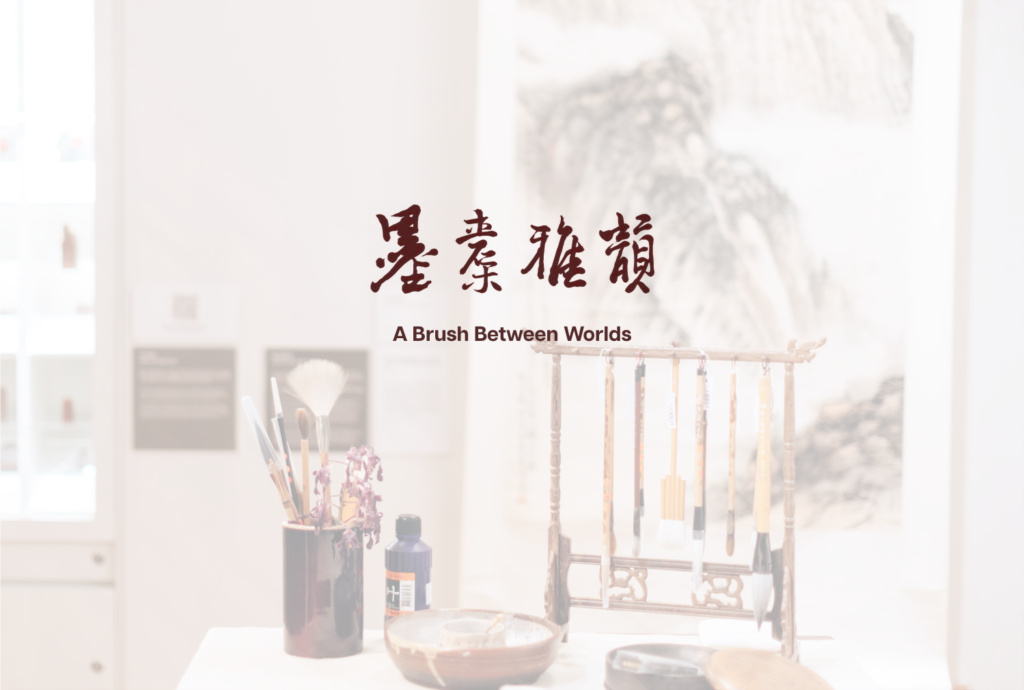
Prof. Chou Chen's Calligraphy, Painting, and Seal Carving curated by Yipei Lee
A Brush Between Worlds
Celebrating the legacy of prominent scholar and the enduring influence of his teachings. Through calligraphy, painting, and seal carving, this exhibition honors the enduring bond between teacher and disciple and the transmission of artistic traditions across generations.
Chinese literati painting is more than the art of brush and ink. It embodies a philosophical tradition and a cultural legacy shaped over thousands of years.
Through three thematic sections, A Brush Between Worlds traces the historical development of Chinese calligraphy and the written script, explores the cultural significance of the Four Treasures of the Study, and presents key works from different stages of Professor Chou Chen's artistic career.
Together with his poetry, calligraphy, paintings, seal carvings, and archival materials, these works reveal the breadth of his artistic achievement and scholarly cultivation.
Following the narrative of brush and ink, visitors enter the artist's world to discover how he continually renews his expressive possibilities while remaining rooted in its cultural values.
Guided by the literati ideal of “traveling ten thousand li and reading ten thousand books,” Chou Chen integrated travel, reading, and artistic practice to achieve a harmony of mind, hand, and brush.
More than the story of a single artist, the exhibition reflects the enduring legacy of Chinese literati painting and the enduring vitality of its cultural spirit.
THE EVOLUTION OF SCRIPT AND CALLIGRAPHY
Chinese characters are among the world's oldest continuously used writing systems. Their evolution reflects the development of Chinese ritual, philosophy, and cultural traditions.
In the Eastern Han dynasty, Xu Shen's Preface to Shuowen Jiezi traced the origins of Ancient Script, the Large and Small Seal scripts, Clerical script, and Cursive script, laying the foundation for the study of Chinese characters.
Archaeological discoveries further reveal their pictographic origins and the close relationship between meaning, form, and aesthetic expression.
The histories of calligraphy and seal carving are inseparable from the evolution of the written script.
The Qin dynasty standardized writing through the Small Seal script, while the Han dynasty saw the rise of Clerical script. Wang Xizhi established the classical tradition of calligraphy in the Jin dynasty.
Masters Ouyang Xun, Chu Suiliang, Yan Zhenqing, and Liu Gongquan refined the Regular Script; and the Song masters Su Shi, Huang Tingjian, Mi Fu, and Cai Xiang championed a more expressive style.
During the Ming and Qing dynasties, the flourishing of both the Model-book and seal traditions further enriched the artistic language of Chinese calligraphy and seal carving.
OBJECTS AS CARRIERS OF CULTURE
The brush is regarded as the foremost of the Four Treasures of the Study. More than a tool for writing and painting, it embodies profound cultural significance.
Human and fish motifs on Neolithic painted pottery already display brush-like marks. According to tradition, the Chinese brush originated with the Qin dynasty general Meng Tian, who fashioned a writing brush from a bamboo shaft and animal hair.
From the Qin and Han dynasties onward, brush-making became one of the finest crafts associated with the Four Treasures.
A quality brush is judged by four characteristics: sharpness, alignment, fullness, and resilience.
Brushes are commonly made from weasel (“wolf”), rabbit, or goat hair, and are classified by flexibility — hard, soft, or mixed — and by size to suit different styles of calligraphy and painting.
During the Ming and Qing dynasties, the brush evolved from a practical writing tool into a treasured scholar’s object. Handles were often decorated with dragons, phoenixes, clouds, and landscapes, while materials expanded to include jade, porcelain, and cloisonné.
For the literati, the brush became not only an instrument of artistic creation but also a means of cultivating thought, perception, and personal expression.
THE CRAFT OF INK
The expression shuxiang mendi — literally “a household of scholarly fragrance” — has long described families devoted to learning.
Its “fragrance” is traditionally associated with the scent of ink, reflecting the close relationship between scholarship and the scholar’s studio.
The history of Chinese ink-making spans more than two millennia. Following traditional methods, the process involves collecting soot, mixing it with animal glue, pressing, drying, polishing, gilding, and carving decorative molds.
The proportion of soot, glue, and mineral pigments directly influences the ink’s texture, color, and performance.
During the Qin and Han dynasties, pine-soot ink became increasingly refined, while the introduction of animal glue and carved molds in the Eastern Han transformed ink from hand-shaped pieces into standardized inksticks.
The flourishing of literati culture during the Song dynasty brought ink-making to new artistic heights. Beyond its writing quality, ink came to be valued for its form, carved decoration, and symbolic meaning, becoming an important expression of scholarly taste.
By the Ming dynasty, inksticks displayed increasingly elaborate forms, often carved with dragons, phoenixes, landscapes, pavilions, and auspicious motifs.
They combined practical function with artistic and collectible value, becoming enduring symbols of the culture of the scholar’s studio.
INKSTONE AS MATERIAL MEMORY
The Eastern Han scholar Liu Xi's Shiming: Explaining Written Forms states: “The inkstone is for grinding; it refines ink so that it becomes smooth and fluid.”
This describes its fundamental function as a tool for grinding and harmonizing ink. Its quality depends on the material itself, giving rise to the Four Famous Inkstones: Duan, She, Tao, and Chengni, treasured objects in the scholar’s studio.
From the Wei, Jin, and Northern and Southern Dynasties onward, as calligraphy, painting, and literati culture flourished, inkstones became increasingly refined in form and craftsmanship.
During the Sui and Tang dynasties, stone, pottery, and porcelain inkstones developed in parallel. In the Song dynasty, literati participated in their design, appreciation, and inscription, transforming inkstones beyond practical tools into expressions of taste and spiritual cultivation.
By the Ming and Qing dynasties, refined carving techniques turned inkstones into works of art valued for appreciation and collection.
As the intermediary between brush and ink, the inkstone enables writing to unfold. Grinding ink is also a practice of concentration and self-cultivation, guiding the scholar into a state of quiet focus before the movement of brush and ink begins.
READING AND INTERACTIVE EXPERIENCE
Having explored “The Evolution of Script and Calligraphy” and “Objects as Carriers of Culture,” visitors are invited to pause and engage more deeply with the cultural world of Chinese calligraphy and painting through reading and hands-on practice.
This area offers a selection of books on Eastern philosophy, Chinese cultural history, and contemporary ink art, alongside writing materials including brushes, water, and water-calligraphy cloth, encouraging visitors to copy Chinese characters and experience the movement of brush and ink, the structure of the written form, and the rhythm of calligraphic practice.
The exhibition also presents publications and video documentation of Professor Chou Chen's calligraphy, ink painting, and seal carving, offering further insight into his artistic journey and daily creative practice.
Through reading, observation, and writing, visitors are invited to discover how contemporary artists integrate art into everyday life, sustaining the traditions of brush-and-ink culture and the humanistic spirit through continuous practice.
FOLLOWING CHOU CHEN'S JOURNEYS THROUGH LANDSCAPES AND THE SPIRIT OF INK
Chou Chen once said: “In painting, calligraphy, poetry, and seal carving, one must have one's own artistic conviction and remain devoted to it, while learning from the strengths of others.”
Rooted in the philosophy of literati painting, this section traces Chou Chen's artistic practice between tradition and innovation.
From Xie He's principle of “spirit resonance and vitality” in the Southern Dynasties, to the refined use of space and emptiness in Southern Song landscape painting, and the rise of literati painting in the Yuan dynasty, ink and brushwork became a means of expressing emotion, character, and inner spirit.
Over four decades, Chou Chen explored the relationship between brushwork, form, and material. Bringing together more than 60 works in calligraphy, landscape and bird-and-flower painting, and seal carving, the exhibition follows his artistic journey — from the discipline of carving, to the structure and rhythm of calligraphic lines, and finally to the expansive world of landscape and the vitality of ink.
LANDSCAPE WORLD
Landscape has been the subject to which Chou Chen has devoted himself most deeply throughout his artistic career. His works draw from both his journeys through nature and the inner world shaped by experience, emotion, and reflection, creating a realm of brush and ink between reality and imagination.
As the Qing dynasty painter Zha Shibiao observed: “Seek the structures of mountains and valleys from what exists in nature; seek the wonders of brush and ink from what does not exist in the world.”
While real landscapes provide the foundation of his practice, the scenes in his paintings do not necessarily depict specific places. Instead, they are transformed through memory, dreams, emotions, and contemplation of the natural world.
His works are therefore not mere representations of scenery, but poetic realms where inner vision and artistic conception converge. The traces of travel, the depth of his imagination, and the resonance of his spirit ultimately flow through brush and ink, creating spaces for wandering, dwelling, and contemplation.